






Jellyfish and Portuguese Man-of-War: How to Identify, Prevent and Act After Contact
Introduction
During the summer months, it is common to see warnings about jellyfish and Portuguese man-of-war along the coast. In most cases, contact causes local pain and skin irritation, but some situations may lead to intense pain or symptoms that require medical attention.
Knowing how to identify these organisms, avoid contact, and respond correctly is essential to reduce complications and stay safe at the beach.
By Paulo Pacheco (Farmacêutico)
Edited by 2026-05-04
Jellyfish and Portuguese Man-of-War: How to Identify, Prevent and Act After Contact
Introduction
During the summer months, it is common to see warnings about jellyfish and Portuguese man-of-war along the coast. In most cases, contact causes local pain and skin irritation, but some situations may lead to intense pain or symptoms that require medical attention.
Knowing how to identify these organisms, avoid contact, and respond correctly is essential to reduce complications and stay safe at the beach.
By Paulo Pacheco (Farmacêutico)
Edited by 2026-05-04
ellyfish or Portuguese man-of-war: are they the same?
No. Although they are often confused, they are different.
Jellyfish (medusae) are gelatinous marine animals that move in the water and have tentacles containing stinging cells.
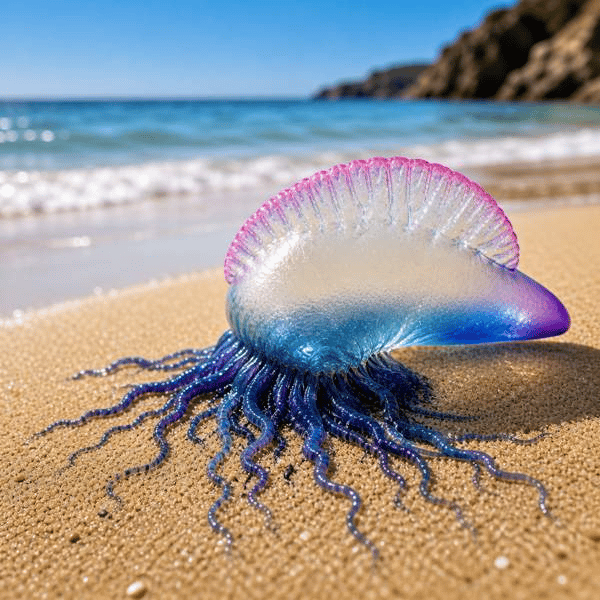
The Portuguese man-of-war (Physalia physalis) is not a true jellyfish. It is a colonial organism that floats on the surface and can be recognized by its blue-purple, balloon-like float. Its tentacles can be very long and may cause more severe reactions.
What happens during contact?
These organisms contain microscopic structures called nematocysts, mainly located in their tentacles. When they come into contact with the skin, they release venom, causing pain and inflammation.
Even out of the water, tentacles can remain active for some time and should never be touched.
Common symptoms
Contact may cause:
- pain or burning sensation
- redness
- itching
- swelling
- linear marks on the skin
- small blisters or welts
The Portuguese man-of-war usually causes more intense and immediate pain.
Warning signs
Seek medical attention if any of the following occur:
- difficulty breathing
- dizziness or fainting
- chest pain
- nausea or vomiting
- severe or persistent pain
- significant swelling
- allergic reaction
- contact in sensitive areas (face, eyes, mouth, or genitals)
What to do after contact
1. Leave the water calmly
This prevents further contact and reduces the risk of accidents.
2. Do not rub the skin
Friction may trigger more venom release and worsen symptoms.
3. Remove visible tentacles
Use tweezers, gloves, or a rigid object. Never use bare hands.
4. Rinse with seawater
Seawater is the safest option.
Avoid fresh water, as it may increase venom release.
5. Apply heat for pain relief
After removing tentacles, applying warm (not hot) water may help relieve pain.
What about vinegar?
The use of vinegar in jellyfish or Portuguese man-of-war contact is controversial.
Although it may be useful for some species, it should not be used indiscriminately, especially when the organism cannot be safely identified.
In the case of the Portuguese man-of-war, some recommendations advise against its use, as it may trigger additional venom release.
👉 Therefore, the safest approach is:
do not apply vinegar unless advised by lifeguards or local authorities.
What not to do
Avoid:
- rinsing with fresh water
- rubbing the area
- applying alcohol
- applying urine
- using sand
- placing ice directly on the skin
- touching tentacles
The use of urine is a common myth and has no scientific benefit.
How pharmacies can help
In mild cases, pharmacies can support symptom relief with:
- pain relief medication
- antihistamines for itching
- soothing skin products
Pharmacists can also help identify warning signs that require medical attention.
Prevention
Prevention is key:
- follow beach warnings and flags
- avoid swimming in affected areas
- do not touch jellyfish or Portuguese man-of-war, even on the sand
- use protective clothing (e.g., rash guards) in high-risk areas
- supervise children near the water
Conclusion
Contact with jellyfish and Portuguese man-of-war is relatively common during the summer, but it can be managed safely with the right knowledge.
Knowing what to do — and what to avoid — can make a significant difference in symptom progression and overall safety.
Sources
This article is based on scientific evidence and recommendations from international organizations such as the National Health Service (NHS), Divers Alert Network (DAN), American Red Cross, Merck Manual, and medical literature on marine envenomation.