



Sun Protection Without False Security: What You Really Need to Know
Most people believe they know how to protect themselves from the sun. They apply sunscreen at the beach, avoid the hottest hours of the day, and reapply “when they remember.” However, according to data from the World Health Organization (WHO) and the European Academy of Dermatology and Venereology (EADV), many cases of skin cancer remain associated with simple, repeated mistakes accumulated over a lifetime.
Ultraviolet (UV) radiation is cumulative — today’s damage adds to yesterday’s. And very often, exposure occurs without us even realizing it.
This article explains, clearly and based on scientific evidence, what it truly means to be protected.
By Paulo Pacheco (Farmacêutico)
Edited by 2026-02-24
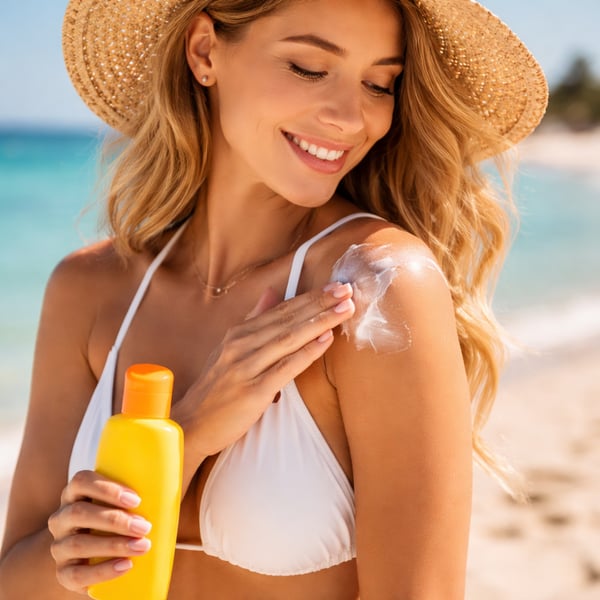
Sun Protection Without False Security: What You Really Need to Know
Most people believe they know how to protect themselves from the sun. They apply sunscreen at the beach, avoid the hottest hours of the day, and reapply “when they remember.” However, according to data from the World Health Organization (WHO) and the European Academy of Dermatology and Venereology (EADV), many cases of skin cancer remain associated with simple, repeated mistakes accumulated over a lifetime.
Ultraviolet (UV) radiation is cumulative — today’s damage adds to yesterday’s. And very often, exposure occurs without us even realizing it.
This article explains, clearly and based on scientific evidence, what it truly means to be protected.
By Paulo Pacheco (Farmacêutico)
Edited by 2026-02-24
What Does the Sun Actually Do to the Skin?
Solar radiation relevant to skin health is mainly divided into two types:
-
UVB – primarily responsible for sunburn.
-
UVA – penetrates more deeply into the skin, accelerates skin ageing, and contributes to cellular changes associated with skin cancer.
An important point:
UVA radiation is present throughout the year, passes through clouds, and even penetrates glass. In other words, relevant exposure can occur even without intense heat or visible sunshine.
SPF: What Does It Really Mean?
SPF (Sun Protection Factor) measures protection against UVB — not UVA.
According to international recommendations:
-
SPF 30 is the minimum recommended level for adequate protection
-
SPF 50 is preferable during intense or prolonged exposure
-
Sunscreen should always provide broad-spectrum protection (UVA + UVB)
In practical terms:
-
SPF 30 blocks approximately 97% of UVB radiation
-
SPF 50 blocks approximately 98%
Although the difference appears small, SPF 50 provides a greater safety margin, especially since most people apply less product than required.
The Most Common Mistakes in Sun Protection
“It’s cloudy, so I don’t need sunscreen.”
Up to 80% of UV radiation can penetrate clouds.
Temperature and brightness are not reliable indicators of UV intensity.
“I’ll only be in the sun for a few minutes.”
Sun damage is cumulative.
Short daily exposures — driving, walking, sitting outdoors — accumulate over time.
This is why daily sunscreen use on exposed areas (face, neck, hands) is recommended.
“I’m in the water, so I’m protected.”
UV radiation penetrates water.
Additionally, water and sand reflect UV radiation, increasing indirect exposure.
Even “water-resistant” sunscreens must be reapplied after swimming.
“I applied sunscreen in the morning.”
Sunscreen degrades with:
-
Sweating
-
Friction from clothing
-
Towel drying
-
Natural sebum production
-
Prolonged UV exposure
The recommendation is to reapply every 2 hours during continuous exposure.
“My moisturiser with SPF is enough.”
It depends.
Many moisturisers contain SPF 15 or 20, which may be insufficient during direct sun exposure.
For facial protection:
-
Preferably SPF 50
-
Applied in adequate quantity
-
Broad-spectrum
Quantity matters significantly — underapplication reduces the actual level of protection.
“I’m tanned, so I’m protected.”
A tan is a biological defence response to UV damage.
It does not replace sunscreen.
Even darker skin tones can develop skin cancer and experience premature ageing.
How Much Sunscreen Should You Apply?
To achieve the labelled SPF:
-
Approximately 2 mg per cm² of skin
-
Roughly one palmful (30–40 g) for full adult body coverage
Most individuals apply about half this amount, significantly lowering effective protection.
Children and Enhanced Protection
Children’s skin is more sensitive to UV radiation.
WHO and EADV recommend:
-
SPF 50+
-
Protective clothing
-
Wide-brimmed hats
-
UV-protective sunglasses
-
Avoiding peak sun hours (approximately 11 a.m. to 4 p.m., depending on latitude)
Sunburns during childhood significantly increase melanoma risk later in life.
Sunscreen Is Only Part of the Strategy
International guidelines clearly state that sunscreen should not be used to intentionally prolong sun exposure.
An effective strategy includes:
-
Seeking shade
-
Adjusting exposure times
-
Wearing appropriate clothing
-
Monitoring the UV Index
Conclusion
The feeling of being protected can be misleading.
UV radiation is silent, cumulative, and active even when we do not feel heat.
Protecting the skin is not an exaggeration — it is prevention grounded in scientific evidence.
Caring for your skin today reduces health risks tomorrow.
Sources
This article is based on scientific evidence and recommendations from international organizations including the World Health Organization (WHO), European Academy of Dermatology and Venereology (EADV), International Agency for Research on Cancer (IARC), American Academy of Dermatology (AAD), and studies published in peer-reviewed journals such as the Journal of the American Academy of Dermatology (JAAD), The Lancet Oncology, and the British Journal of Dermatology.